Useful alternatives exist
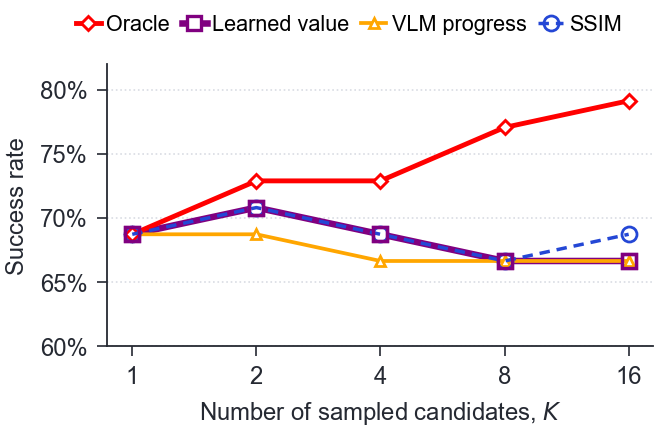
In the initial same-state study, an outcome-informed oracle increases success from 68.9% to 79.2% compared with uniform selection. This measures opportunity within the sampled candidates.
World action models · Test-time planning
A Study of Test-Time Planning
with World Action Models
1 University of Oxford2 Purdue University3 UWE Bristol
The question
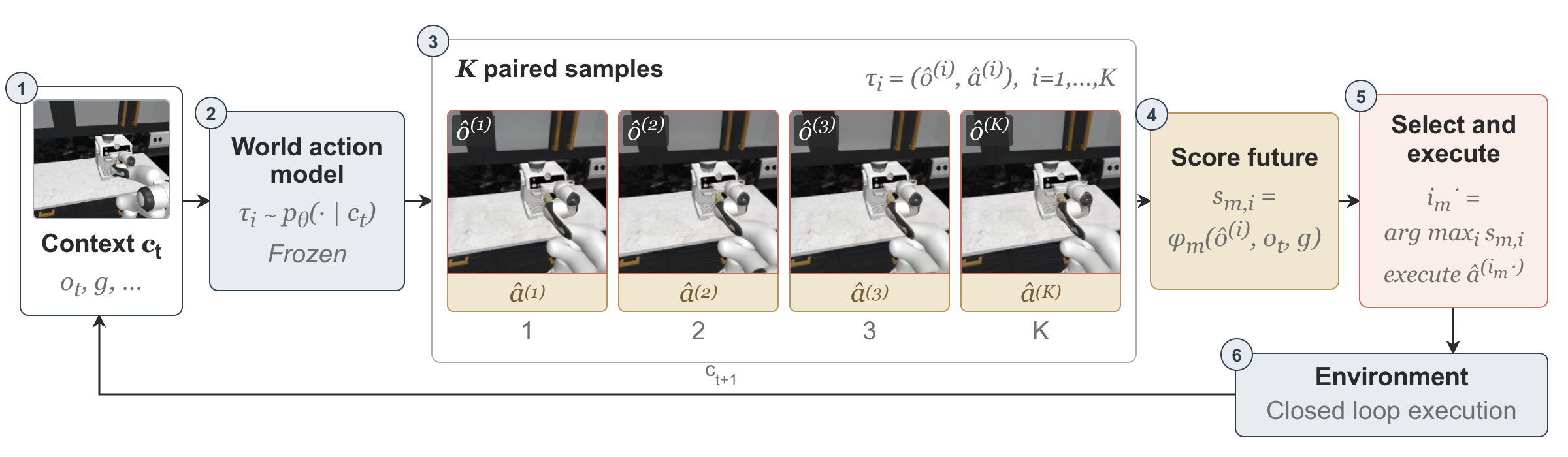
World action models generate actions together with visual predictions of their consequences. Sampling several pairs creates a choice. We study when these predictions provide useful evidence for making that choice.
Producing better action choices and recognising them in generated futures are two different problems.
A controlled study
We hold the pretrained world action model fixed, sample paired actions and predicted futures, then change the score used to select a candidate. The robot executes the corresponding actions and observes the environment again.
What we learn
In the initial same-state study, an outcome-informed oracle increases success from 68.9% to 79.2% compared with uniform selection. This measures opportunity within the sampled candidates.
Some selectors yield higher observed success, but gains are uneven. Visual quality, physical consistency and task progress scores do not consistently identify the better action.
Numerically different actions need not produce different task outcomes. We analyse candidate outcomes and score rankings to distinguish limited choice from failures to recognise useful alternatives.
The primary study uses Cosmos Policy in RoboCasa. The initial same-state comparison covers 48 decision states across four tasks with 16 candidates per state; these percentages are not full-benchmark success rates. Further experiments test complete action execution and additional model interfaces.
Minimal research code
A small, readable starting point for future-based action selection. Try the CPU smoke test, then connect Cosmos Policy using the included adapter.
git clone https://github.com/\
YuanJianhao508/Beyond-Visual-Quality.git
cd Beyond-Visual-Quality
python -m venv .venv
source .venv/bin/activate
pip install -e ".[dev]"
python examples/toy_demo.py
pytest
The synthetic demo tests the interface. It is not a robot experiment or a reproduction of the paper’s results.
Reference
The preprint has been submitted to arXiv. The identifier will be added when it is publicly available.
@misc{yuan2026beyondvisualquality,
  title  = {Beyond Visual Quality: A Study of Test-Time
            Planning with World Action Models},
  author = {Yuan, Jianhao and Yuan, Yu and Ramtoula, Benjamin
            and Vierling, Lukas and Newman, Paul and Kunze, Lars
            and Torr, Philip and De Martini, Daniele},
  year   = {2026},
  note   = {Preprint},
  url    = {https://yuanjianhao508.github.io/Beyond-Visual-Quality/}
}